“The problem with media scholars”, a professor of pedagogy told me during my first week as a PhD candidate, “is that they like the media”.
Personally, I would not feel comfortable admitting I “like the media” in such broad strokes. Perhaps because I’m old enough, and left-wing enough, to remember when questions about mainstream media were more about how to curtail their powers than how to protect them from the even less transparent and democratic “social” media giants. I do, however, love movies, and I do admire anyone who makes them.
After about six months as a PhD candidate, I attended a symposium on media industry research in Bristol. Among the research projects presented were studies on independent production companies, the media hub of Bristol, working conditions of Bristol-based media freelancers, the experiences of first-time feature film producers and my own PhD project on the challenges the Norwegian film industry faces in digital movie markets. One common thread among these projects is that they all chose not to analyse the actual media texts produced by these various companies. In other words, there was no examination or evaluation of the quality or merit of the output. However, there seemed to be an implied evaluation of this output as a positive in the choice of research subjects.
In their “In defence of a political economy of the media,” Meehan and Wasko argue that the work of scholars in “critical media industries” is “celebratory” rather than “critical”, and that “critical” and “celebratory” approaches exist in opposition to each other” (2013, 40). I contend, however, that this opposition between the theoretical approaches discussed in the previous chapter is not theoretical at all, but ethical and ideological. It is less a question of what the critical media industries, cultural industries research or political economy approaches can achieve, but what their proponents want to achieve.
According to Helen Longino, “members of the research community often exhibit the same social values and ideologies inherent in the social context within which the research takes place” and “researchers ought to attend to the way contextual values, especially gender bias and racial bias, occur in research” (1994, 139).
So while I might not agree with the professor of pedagogy that the problem with media researchers is our enjoyment of media, it is certainly important that I as a media researcher try to be aware of the values I bring into my research. This includes my love of movies and admiration of those who make them, as well as my age (44)1, my gender (cis male), my class background (middle), and my upbringing in the less-than-central parts of a small European nation with relatively limited cultural production.
I do share Meehan and Wasko’s view that research is political, and my hope is that this work will have impact. I hope to not only extend scholarly knowledge about what happens when a small nation is beset by global media giants, but also to contribute to the continued and improved health of the Norwegian film industry and to sound cultural policy. This is clearly an ethical, even moral, statement that puts me and my research at odds with what Longino calls “standard ethics”.
In her article “Gender and Racial Bias in Scientific Research” Longino challenges a “standard conception of the relationship between science and values” in which contextual values are considered external to scientific inquiry and to introduce them is considered bad science (1994, 139). Ethics is likewise understood as an external regulating factor on scientific practice and concerned primarily with avoiding harm and/or bad science.
Yet, Longino argues, “[n]ot all ethical or value issues are external to the productive aspects of research”. This transforms ethics from “relatively straightforward questions regarding what counts as reasonable constraints (…) to more elusive and complex problems and assessing the background values and of empirical knowledge claims.” (1994, 140)
In returning to the projects presented at the symposium in Bristol, we can see shared contextual values, primarily in the questions posed and in the research practices. All projects aimed to examine different aspects of what we could consider precarious actors in the media industry – they were all small and/or regional in an increasingly globalised media industry. While such research need not necessarily be explicitly value-laden, they imply that these precarious parts of the media industry produce content worth supporting or protecting.
Eva Bakøy, Roel Puijk and Andrew Spicer – the latter two present at the Bristol symposium – discuss similar questions in their introduction to Building Successful and Sustainable Film and Television Businesses. While acknowledging that the collection’s “focus on ‘success’ might be unduly celebratory”, they argue that the companies they study are “struggling entrepreneurs that contribute to diversity” and that this calls for a “sympathetic (…) while far from uncritical” attitude (2017, 4).
The various contributions in Building Successful and Sustainable Film and Television Businesses share another commonality with the research presented at the Bristol symposium; they were mainly based on interviews with industry professionals. Some of these built on existing networks, either from the researchers own professional backgrounds or networks developed from previous research.
It is because of this closeness that Meehan and Wasko argue that this line of research is “(ultimately) a celebration and reaffirmation of the status quo” (2013, 49) and that researchers must lose the “political” aspect of “political economy” to be able to establish working relationships with the media industries (Wasko and Meehan 2013, 156).
There is a danger that the values, questions, and practices of media industry researchers can cause them to view themselves, or act as, a semi-independent support system for the media industry. The idea that humanities research should support the creative industries certainly has support among governments. In June 2019 David Hesmondhalgh tweeted an image of a section of the new Delivery Plan from the UK Arts and Humanities Research Council (AHRC) that included the following quotation: “The creative industries stand to AHRC as the healthcare system does to biomedical research (…)”. To which Hesmondhalgh responded, “Anyone else troubled by this language?” (2019)
Am I troubled by this language? Does my love of movies and admiration of the people who make them cloud my judgement? I cannot speak for the whole of media industry research or even a small symposium in Bristol. However, when examining my own PhD project, it is clear that at least this researcher does see his research as something that could and should support at least one small part of the media industry. The research questions I pose are thus clearly influenced by my values as someone who wants to support a Norwegian film industry threatened by global American giants.
The same could be said about my choice of methods. By choosing qualitative interviews with industry executives, I obviously believe their perspectives are valuable and that insights from industry actors can be useful in developing theory, and ultimately also media policy and/or strategy. This choice of methods has, however, also affected my perspective. While I remain personally uninterested in most Norwegian blockbusters and popular comedies, this research project has made me more sympathetic to the difficulties faced by commercial movie creators in a small market like Norway. So, in spite of my goal to undertake research situated in the “critical” tradition of political economy research, I clearly also run the risk of conducting and producing the kind of research Meehan and Wasko consider “celebratory”.
Longino encourages researchers to explicate values that might otherwise be left implied or simply assumed, which is vital to highlighting the dilemmas outlined above, but she does not offer further guidance in solving them. In her book Science, Policy, and the Value Free Ideal, Heather Douglas tackles the often messy interactions between scientists and policymakers. On one hand, she rejects the idea that science “provides certainty” and points to feminist researchers like Longino whose work centres the ways societal values influence the creation of scientific knowledge. On the other hand, Douglas argues that despite not being able to claim certainty, “science has been stunningly successful as the most reliable source of knowledge about the world” (2009, 2). For Douglas, the question of implicit values thus becomes a moral one. Scientists have a moral obligation to consider the possible consequences of their policy advice and possible errors in their work, but these considerations should also take into account the potential consequences of inaction (2009, 66, 70). When faced with uncertainty, and only then, Douglas argues, do “social and ethical values have a legitimate role to play when deciding, based on the available evidence, which empirical claims to make” (2009, 81).
In the end, I come to similar conclusion regarding my own research. No theoretical or methodological choice insulates a researcher from having to make decisions based on “social and ethical values”. Using methods and asking research questions that put researchers close to media industries practitioners and companies, and/or that tries to understand their perspectives, does not inevitably result in “celebratory” research. Moreover, such subjects can provide insight that cannot be derived from other sources – especially when studying small markets like the Norwegian movie market.
While all Norwegian distribution and production companies are small in the face of the global industry, but are vast differences between the them. If my aim is to be able to give policy recommendations based on my research, it cannot be taken for granted that such recommendations would be good for every company. If so, would I be inclined to give recommendations that favour the companies I have studied directly? Or companies that have been involved in movies I like personally, even if my research is not considering the films distributed? Would I consider the smallest and most precarious companies as the most important ones, or the larger ones that make the most popular movies? Douglas’ principles, applied to my project, would prevent me from deliberately skewing the research to favour certain companies, but if faced with uncertainty I would be allowed, or even expected, to make a moral/value-based judgement on the possible outcomes.
The data
This thesis uses both quantitative and qualitative data from historical sources, interviews, and observations.
Historical data
A large share of part 2 and elements of part 1 are based on quantitative data about Norwegian film distributors during the period 2008 to 2018. This data was collected from various sources and assembled into databases that have allowed for various cross analyses.
2008 was chosen as a starting year because it was a commercial breakthrough year for the Norwegian film industry2. It was the first time in more than 30 years that the Norwegian movies sold more than 2.5 million tickets3, and since 2008 yearly admissions have continued to average 2.5 million.
The historical data were provided by several sources. Data on cinematic releases and admission numbers were provided by the industry association Film & Kino. A database of titles released in the Norwegian home entertainment market was provided by the Norwegian Media Authority. Data on genre and length of Norwegian cinematic releases were provided by the ticket sales and film promotion portal Filmweb.no. Release dates for DVDs and Blu-rays released after 2015 were provided by Platekompaniet, a leading national retailer.
The Norwegian Film Institute (NFI) provided the empirical data for a series of reports on the availability of Norwegian films on various TVOD and SVOD platforms, as well as data about support awarded to production companies between 2012 and 2016 and support awarded to distribution companies after 2013. I also collected more detailed admissions numbers from filmweb.no, using a web scraper. Further details on data and methods are included in the appendix.
Interview data
Chapter 5 consists of two case studies based mainly on interview data. For the first case study, I conducted 11 interviews with key personnel in two major Norwegian distribution companies, SF Studios and Nordisk Film Distribusjon. These companies released about half of all Norwegian titles in 2019, and took in 84%4 of Norwegian title admissions. The interviews were performed on a quarterly basis from early 2019 until summer 2020.
The second case study examines the release of the film Barn(Haugerud 2019). For this study, I did group interviews with the producer, the distributor, and the home entertainment distributor. I conducted four interviews with this group, although only the producer and distributor were present at the first one. The interviews were conducted before the cinematic release, right after the home entertainment release, six months after cinematic release and 18 months after cinematic release.
All interviews were conducted in Norwegian, and the selected quotes have been translated to English. In these translations I have prioritised tone and intent over literal meaning.
Observational data
According to Matthew G. Kirschenbaum (2021) all digital data is simply a long stream of bits – 0’s and 1’s – that are temporarily called into action as text, sound, images, numbers, and so on. While the data I have collected using observation is technically no more or less digital than the historical data, this image of “the bitstream” resonated with me as I tried to gather data that was only available to me from the internet.
While I had numerous sources of data on cinema and physical releases, there was no paper trail for digital releases. Finding digital release dates was impossible without insider access. There was, additionally, no public sharing of sales figures5. During the first interviews, it became apparent that the distributors themselves had no information about discoverability and prominence of their own titles on digital platforms. Data that are publicly accessible through advertising, cinema listings, and charts for movies released in physical formats decades ago now, at best, require insider access after mere moments.
Kirschenbaum also describes the bitstream as “the vast sea of digital data we encounter every day (2021, x). From my perspective, this bitstream quickly became a river, and it became apparent that unless I started some sort of systematic observation, the data would pass me by and never be accessible again6.
I first attempted to automate observations with a web scraper. In August 2019, I began using a web scraper to download the iTunes and Google Play Store top charts for movies to a spreadsheet. However, in October iTunes removed the top charts from the apple.com webpage; this information was now only available in the iTunes Store app, which I was unable to scrape. I continued scraping the Google Play Store until November 2019. At that point, no non-Hollywood title had yet to breach the top 60 list, and I concluded this data was not relevant to this thesis.
I also used a web scraper to examine the prominence of movies in the home entertainment market. However, these efforts were unsuccessful because the web scraper read the underlying code of the web page, and not the screen presented to a user (see also Berry and Fagerjord (2017) p. 126).
In the end, I turned to manual observations to build two databases. One charted release dates for all Norwegian movies debuting in 2019 and was used to calculate release windows. The other contained observations of Norwegian titles across several home entertainment platforms and was used to analyse prominence and pricing. Since data not observed would be lost, I began observations before I completed the framework for the latter database. As a result, more services and more detailed information was added as the observations progressed, which forced me to use slight variations in how the data is analysed in the two case studies.
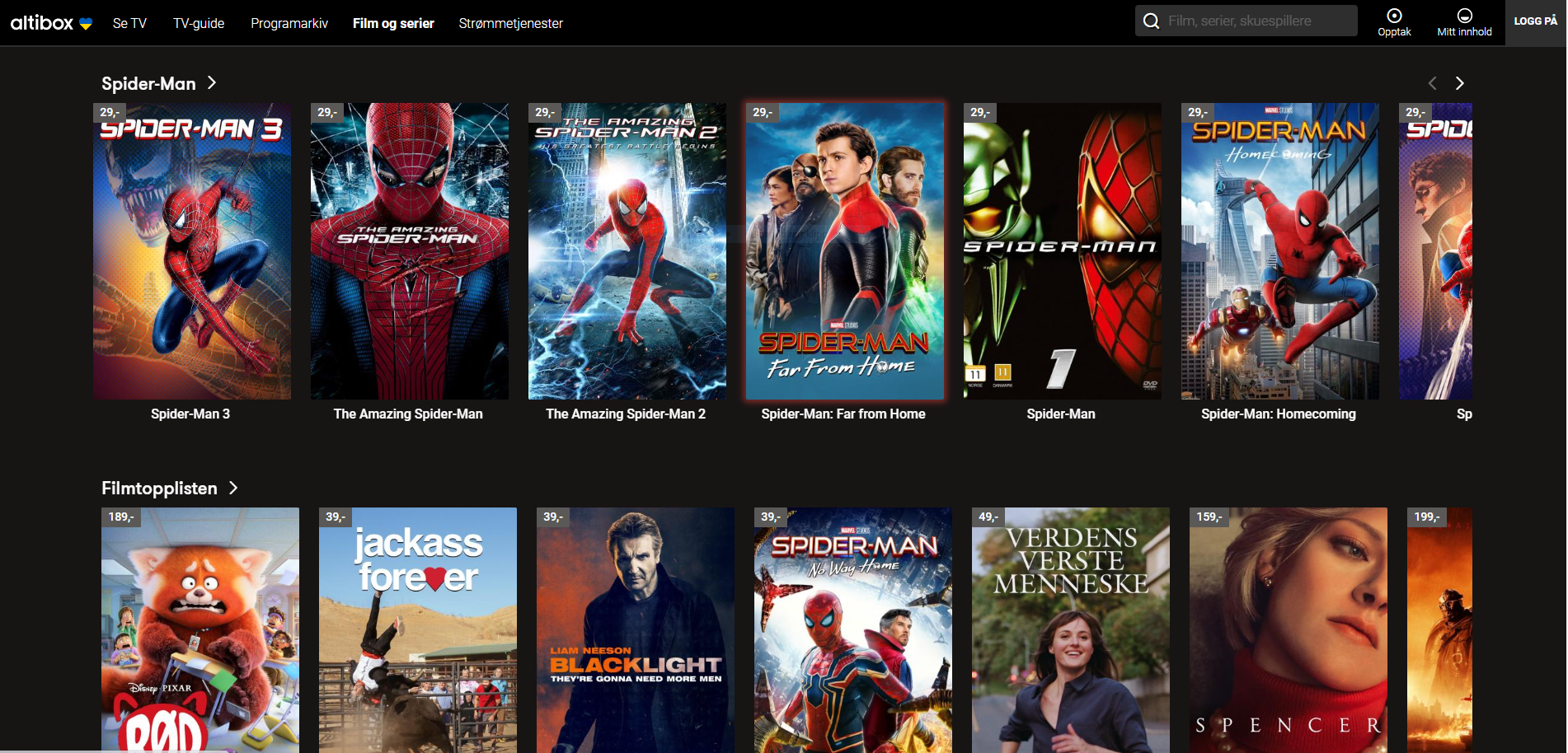
In its final form, the database drew largely on Catherine Johnson’s article “Beyond catch-up” (Johnson 2017), in which she depicts the basic interface of the ITV player as a table. Every home entertainment platform I observed used a similar grid-based layout as the ITV player Johnson examined, so a similar approach could be adopted. When viewed as a table, any title’s position within a grid-based layout could be described in a spreadsheet, and thus used for quantitative analysis.
The above screenshot, taken a few rows down to find a Norwegian title, would be represented like this:
While most of the theoretical grounding of this thesis is found in cultural industries studies, a field with its roots in sociology, the methodology is rooted in the humanities. Many of the steps along the way utilise concepts and methods from other relevant fields, but the data are ultimately read in an effort to create concepts that advance understanding. Throughout the writing of this thesis, theoretical concepts have been applied to the empirical data in ways that have given me a stronger insight into the data, which in turn has improved the framing of the concepts I developed. Thus, in a hermeneutical fashion, the theory and the data feed into each other.
Time and space
Choosing to write this thesis as a monograph rather than the (in Norway) currently more popular article-based thesis was a methodological choice. A monograph offered more time to collect data and more space to present the findings.
Some readers might find that I’ve used more of that space than necessary on details that they dismiss as descriptive. I contend that in Part 2 of this thesis I present not only new material, but also a subject that has not been given scholarly attention before now. In this context it was important for me to present material in ways that not only opened my work for scrutiny, but also be of use for further studies.
Norway is also a small nation in terms of film industries studies, and there are many aspects that lack comprehensive studies. I’m very aware of how crucial seemingly irrelevant details and asides in the work of others has been for me, and perhaps this thesis can leave some valuable nuggets for others to find. In Bent Flyvbjerg’s words, “the goal is to allow the case to be different things to different people” (2006, 238).
By writing a monograph, it was also easier for me to extend the data collection period to the point where I could follow all Norwegian movies released in 2019 throughout their first year in the home entertainment markets. I could also extend the period of interviews, which ended up covering about 18 months.
Ryfe (2016) discusses the importance of spending time in media production research, and how current policies and practices in academia prevent this. Even though my research interviews are far less time-consuming than the kind of ethnographic research Ryfe discusses, I was aware that opportunities to extend a data collection period like this might not come too often.
I had also spent time with Norwegian distributors before the work on this thesis began. I interviewed informants from SF Studios7, Arthaus and Euforia for my master’s thesis (2011). I have also written for Rushprint, the Norwegian film industry trade magazine, both as an academic commentator and as a paid freelance journalist. This work put me in frequent contact with distributors and others in the Norwegian film industry.
During the period I was working on this thesis I spent time with the Norwegian film industry separate from the research interviews. Pre pandemic I attended film festivals and other industry gatherings when possible, and was able to talk with distributors, NFI and others in semiformal settings. All of this helped me get the access to distributors that I needed for my chosen methods.
Levels of inquiry
In part two of this thesis, the analysis employs three different perspectives. In Chapter 4 I analyse the strategies of all Norwegian film distributors using mainly quantitative data from the period 2008 to 2018. This analysis moves between a macro level, where the changes and strategies are considered as a whole, and a meso level, where the strategies of individual and smaller groups of companies are analysed.
In Chapter 5 I present two case studies. The first examines the 2019 slate of the two major local distributors, SF Studios and Nordisk Film Distribusjon. This case study uses quantitative, observational and interview data and moves between a meso-level analysis, where companies are analysed and compared to the other distributors, and a micro-level analysis, where individual films and specific decisions are discussed. The second case study stays at a micro level and follows the release and reception of a single movie, Dag Johan Haugerud’s Barn, using qualitative and observational data.
Quantitative methods
While I hesitate to call this work “digital humanities”, it is certainly inspired by work in the digital humanities such as Berry and Fagerjord (2017), and Ross, Grauer, and Freisleben (2015). I hesitate because “digital humanities” hopefully remains a more meaningful term than “a humanities’ scholar with spreadsheet software”. The data I have collected and analysed is data of a type available for study long before digital tools became common, and several studies of the Norwegian film and cinema industry have relied significantly on quantitative methods (Moseng 2017, 2016; Solum and Asbjørnsen 2008, 2000).
However, the growing field of digital humanities has made me aware of what a single researcher armed with quantitative data, spreadsheet software and basic programming skills can achieve. An influence of what Berry and Fagerjord describes as “computational thinking” (2017, 52–53) is evident in the way I have organised and shared my data. While my programming skills have limited me spreadsheet software rather than dedicated database software, the data has still been organised according to basic database principles which allowed for cross-referencing data from multiple sources. I have also made all data used, both the sources and all tables, with documentation, available on mariusbax.no/norwayafternetflix8
Using digital tools, I have been able to combine data from several sources, and analyse much more data than I would otherwise be able to. I have also been able to collect data using a web scraper that while public was not available to download9. Most of all, I have been able to perform many calculations and visualisations quickly, allowing me to find relevant patterns and move between theory and data.
However, while my use of spreadsheets became rather sophisticated - several potential approaches stranded on my lack of coding skills. A proper application of a digital humanities approach to my data could for instance examine the degree of blockbusterification by calculating the share of total weekend admissions that the top performing titles took, or map the relationship between admissions and distributors, producers, directors and so on by connecting the data examined in this thesis to databases such as IMDb or Norsk filmografi.10
Quantitative data methods were applied to analyse the strategies of Norwegian distributors as patterns and positions (Mintzberg 1987). More detailed discussion the methods and findings of this analysis is found in Appendix.
Qualitative methods
Chapter 5 presents two case studies that examine strategies of local distributors as plans and perspective (Mintzberg 1987). These case studies augment the broader analysis and bring a deeper understanding to how and why distributors make their decisions. In a Flyvbjergian typology of case studies, the two cases in this thesis can be classified as “maximum variation cases”, “critical cases” and “extreme cases”. Maximum variation cases vary significantly in one dimension, while extreme cases are those that are unusual, and critical cases “have strategic importance” and “permit logical deductions”. In other words, what is true or false in a well selected critical case can reasonably be applied to other instances (Flyvbjerg 2006, 229–30).
My cases are “maximum variation cases” because SF Studios and Nordisk Film Distribusjon are the most market-oriented local distribution companies and rely on attracting large audiences, while Arthaus is among the companies with the strongest artistic profile and relies heavily on government support. The three companies vary significantly in size, but are not among the smallest distribution companies in the Norwegian market.
The case study of SF Studios and Nordisk Film Distribusjon was chosen as a “critical case”. Among the distributors that release Norwegian movies they were likely to exert the most circulation power. As part of Scandinavian conglomerates they have access to considerable economic resources and together they distribute about half of all Norwegian movies. If there were strategies that they did not have the resources to employ, or if they struggled in the home entertainment markets, it would be unlikely any other Norwegian distributors could succeed where they had not.
Barn is a film with unapologetically high artistic ambitions that, given its theme and length, was from the outset an unlikely candidate for commercial success. It also turned out to be a “critical case” – during the course of my interviews, the producers revealed that they had tried, unsuccessfully, to launch with a day-and-date release. If cinemas would not agree to a day-and-date release of a movie with high artistic integrity and low admissions potential, it seems unlikely that they would agree to a day-and-date release for more commercial titles where a day-and-date release would be more likely to cost cinemas admissions.
The interviews that generated the qualitative data for the case studies were semi-structured based on an interview guide I had prepared. In each interview systematically discussed each release in the upcoming windows, as well as the performance of each recent release. This allowed me to get a sense of their expectations as well as their experiences close to when the decisions were made. The interviews also made room for more general reflections and discussions on the role of foreign titles.
The informants were what Hanne Bruun considers “exclusive informants”. Exclusive informants are elite informants that give “insight into what is going on backstage” (2016, 134). This makes them irreplaceable; if they do not participate in a study, it cannot take place. While not all potential informants I approached wanted to be a part of the study, enough consented to make it viable.
All informants were given the opportunity to review quotations and were offered varying degrees of anonymity. Bruun argues that anonymity and confidentiality “will harm the validity of the research” (2016, 143). I have, nevertheless, chosen not to name my informants in any of the cases, and have also anonymised several quotations in the first case study.
The decision not to name the sources beyond the companies they work for is mainly a stylistic choice; it is not difficult to identify the producer of Barn, for example. However, in the case-based on interviews with SF Studio and Nordisk Film Distribusjon, I wanted to offer both companies a level of “plausible deniability” for any remarks not directly tied to one of the companies. This was to allow me to use quotations and information from the interviews that the companies might fear would generate negative reactions from third parties. Leaving ambiguity around which of the companies certain statements originated from struck a good compromise between wanting to include the quotations and avoiding harm to the companies.
Only minor revisions to the quotes were requested from the informants – corrections of minor misunderstandings, the removal of identifying details, and minor rewording of statements that informants believed sounded brash in writing. Bruun’s reflection on the different tempo in media industries and media research also came into play here – some information was given to me confidentially during the interviews, but all of it is now public knowledge.
To conclude, Bruun also reflects on the agendas that exclusive informants might possess, arguing that they must “be regarded as part of the research findings” (2016, 142). In many cases in my research, the informants were very open about their agendas, both when they were trying to achieve internal change as well as in the external changes they wanted to see. Nevertheless, in the case studies presented here, I have attempted to separate my analysis from the interview data so that it is clear when the perspective of the informants is presented.
References
Bakøy, Eva, Roel Puijk, and Andrew Spicer, eds. 2017. Building Successful and Sustainable Film and Television Businesses : A Cross-National Perspective. Intellect.
Berry, David M., and Anders Fagerjord. 2017. Digital Humanities: Knowledge and Critique in a Digital Age. Cambridge: Polity.
Bruun, Hanne. 2016. “The Qualitative Interview in Media Production Studies.” In Advancing Media Production Research: Shifting Sites, Methods, and Politics, edited by Chris Paterson, David Lee, Anamik Saha, and Anna Zoellner. Global Transformations in Media and Communication Research. Houndmills: Palgrave Macmillan.
Douglas, Heather E. 2009. Science, Policy, and the Value-Free Ideal. University of Pittsburgh Press.
Johnson, Catherine. 2017. “Beyond Catch-up: VoD Interfaces, ITV Hub and the Repositioning of Television Online.”Critical Studies in Television 12 (2): 121–38. https://doi.org/10.1177/1749602017698159.
Kirschenbaum, Matthew G. 2021. Bitstreams: The Future of Digital Literary Heritage. Material Texts. Philadelphia: University of Pennsylvania Press.
Lobato, Ramon. 2017. “Rethinking International TV Flows Research in the Age of Netflix.”Television & New Media, 152747641770824. https://doi.org/10.1177/1527476417708245.
Longino, Helen. 1994. “Gender and Racial Biases in Scientific Research.” In Ethics of Scientific Research. Issues in Academic Ethics. Lanham, Maryland: Rowman & Littlefield Publishers, Inc.
Mintzberg, Henry. 1987. “The Strategy Concept I: Five Ps For Strategy.”California Management Review 30 (1): 11–24. https://doi.org/10.2307/41165263.
Moseng, Jo Sondre. 2016. “Produksjonslandskapet i Norsk Film.” In Bak Kamera: Norsk Film Og TV i Et Produksjonsperspektiv, edited by Eva Bakøy, Roel Puik, and Tore Helseth.
———. 2017. “The Film and Television Industries in Norway.” In Building Successful and Sustainable Film and Television Businesses : A Cross-National Perspective, edited by Eva Bakøy, Roel Puijk, and Andrew Spicer. Intellect.
Øfsti, Marius. 2011. “Den nye kinoen: digitaliseringen av norske kinoer 2010-2011.” Master’s thesis, Trondheim: NTNU.
Ross, Michael, Manfred Grauer, and Bernd Freisleben. 2015. Digital Tools in Media Studies: Analysis and Research. An Overview. 1st ed. Vol. 27. Medienumbrüche. Bielefeld: transcript Verlag.
Ryfe, David M. 2016. “The Importance of Time in Media Production Research.” In Advancing Media Production Research: Shifting Sites, Methods, and Politics, edited by Chris Paterson, David Lee, Anamik Saha, and Anna Zoellner, 38–50. Global Transformations in Media and Communication Research. Houndmills: Palgrave Macmillan.
Solum, Ove, and Dag Asbjørnsen. 2000. Det Norske kommunale kinosystemet: legitimeringsstrategier og filmrepertoar. Vol. nr 39. Skriftserie fra Institutt for medier og kommunikasjon, Universitetet i Oslo (trykt utg.). Oslo: Institutt for medier og kommunikasjon, Universitetet i Oslo. http://urn.nb.no/URN:NBN:no-nb_digibok_2013062406027.
Wasko, Janet, and Eileen R. Meehan. 2013. “Critical Crossroads or Parallel Routes?: Political Economy and New Approaches to Studying Media Industries and Cultural Products.”Cinema Journal 52 (3): 150–57. https://doi.org/10.1353/cj.2013.0028.
2006 could have been chosen as an artistic breakthrough with Reprise(Trier 2006) winning awards at Toronto and Karlovy Vary among others, and Den brysomme mannen(Lien 2006) premiered at the Cannes festival.↩︎
In Norwegian cinemas. While income from Norwegian movies abroad also rose sharply in the period, it has remained “very modest” (Moseng 2017).↩︎
Nordisk Film Distribusjon took in more than half of all admissions for Norwegian movies in 2019 alone.↩︎
A best-seller chart for the Norwegian TVOD/EST market, Filmtopplisten, was launched in 2021.↩︎
This was, unfortunately demonstrated as I, for a period of four weeks in 2020, forgot to note the iTunes Top Charts.↩︎