# uploaded yearly admissions data from filmweb scrape using Octoparse in 2022 to open refine# did additional scrape of details for each film from previous scrape on filmweb using Octoparse in august 2024, and uploaded data to open refine# manually added details for Fuglane and DU in open refine# upload data on minimum marketing budgets and reported budgets collected manually in 2019/2020 to open refine# added updated marketing budgets from NFI (page sourced in notes)# manually added filmweb_id to marketing and budget dataset# uploaded datasets with statistics from Film & Kino on norwegian cinemas from 1979 to 2019 to open refine. The data from 1979 to 2000 was copy/pasted and cleaned from a yearbook number. The data from 2000 to 2019 added manually. Ideally complete dataset for the entire period should be included later.#all datasets cleaned in Open Refinelibrary(rrefine)library(tidyverse)library(gt)library(ggplot2)library(plotly)# download refined datafilmweb_data =refine_export(project.name ="filmweb_film_data")filmweb_yearly_admissions =refine_export(project.name ="filmweb_yearly_admissions")marketing_and_budgets =refine_export(project.name ="norwegian_films_2019_marketing_and_budget")norwegian_cinema_stats_1979_2019 =refine_export(project.name ="norwegian_cinema_stats_1979_2019")# lose the "norwegan_title" column as it caused an errormarketing_and_budgets = marketing_and_budgets [,2:7] #add premiere_year column filmweb_data = filmweb_data %>%mutate(premiere_year =as.double(substr(norwegian_premiere,nchar(norwegian_premiere) -3, nchar(norwegian_premiere)))) #replace NA values in production year column with premiere year and NA values in premiere year with production year filmweb_data = filmweb_data %>%mutate(premiere_year =coalesce(filmweb_data$premiere_year, filmweb_data$production_year)) %>%mutate (production_year =coalesce(filmweb_data$production_year, filmweb_data$premiere_year))#filter out Norwegian films from 2019 - note that there were no maj. Norwegian co-productions released in 2019. If there had been more advanced filtering would have been nessescary. *Barn* is listed with production year of 2018, and there were a few old films re-released in cinemas nessecitating a filter for films newer than 2017norwegian_films_2019 = filmweb_data %>%filter(premiere_year ==2019) %>%filter(production_country =="Norge") %>%filter(production_year >2017)#get total admissons pr titlefilmweb_total_admissions = filmweb_yearly_admissions %>%group_by(filmweb_id) %>%summarise(total_admissions =max(total_admissions))#add admissions data to 2019 Norwegian premieresnorwegian_films_2019 =left_join(norwegian_films_2019,filmweb_total_admissions)marketing_and_budgets =left_join(marketing_and_budgets, norwegian_films_2019)norwegian_films_2019 =left_join(norwegian_films_2019, marketing_and_budgets)
There is a gap between the strategy research done by media and cultural industry researchers and the work done by strategy researchers in business studies. In the media and culture industry research, the term “strategy” is often vaguely defined. This hampers the development of a deeper understanding of strategy in the cultural industries, even when the findings and analysis are solid.
In business studies, strategy is often normative rather than descriptive and aimed at improving strategic choice, while cultural industry research mainly wants to understand the industries. When business studies researchers discuss strategies in the cultural industries, they are also often focused purely on the economic side and ignore the other reasons for producing cultural expressions. In this thesis, I hope to bridge this gap by bringing terminology from descriptive strategy research in business studies into the cultural industries field.
One reason to attempt to bridge this gap is that the existing cultural industries theory on strategy is largely adapted to large markets. In Chapter 1 I argue that several of the key strategies identified in the literature are unlikely to be applicable to the Norwegian film industry.
Increased production value and heavy marketing
Norwegian movies are incredibly cheap to make compared to movies made in larger markets. The entire 2019 slate had a budget of NOK 550M and included movies in costly genres such as historical drama with Amundsen(Sandberg 2019) and Spionen(Jonsson 2019) as well as the fantasy adventure Askeladden i Soria Moria slott(Sandemose 2019). It still only equalled about 15% of Avengers: Endgame(Russo and Russo 2019). The highest ever budget of a Norwegian movie is reportedly the upcoming war drama Krigsseileren(Vikene 2022), which at NOK 100M would have a production budget comparable to Book Club(Holderman 2018) and If Beale Street Could talk(Jenkins 2018), neither of which would be described as high-budget. In fact, the average budget for a Norwegian movie in 2016 was only NOK 24M1(Gaustad et al. 2018). Average budgets had remained at between NOK 15M and 20M from 1999 to 2015, despite general cost increases (Moseng 2016).
Despite the low budgets compared to US movies, the differences between budgets is considerable. Even if we exclude documentaries, the most expensive 2019 title, Amundsen had almost ten times the budget of Disco(Syversen 2019) and Hjelperytteren(Jacobsen 2019). However, we see little correlation between production budgets and admissions in 2019.
Marketing budgets are more closely connected to admissions, but again it does not seem possible to achieve success by spending alone. Several movies with shoestring production budgets and no NFI marketing support, received higher admissions then Hjelperytteren.
While marketing budgets for Norwegian movies are not made public, NFI’s marketing support scheme requires producers to match NFI funding. In 2019 this was capped at NOK 2.1M2. While the marketing budgets for some of those titles surpassed NOK 4.2M3, marketing budgets nonetheless remain low compared to production budgets.
More extensive study may, of course, reveal a greater correlation between high admissions and high budgets. But from the 2019 data it seems that while increasing budgets can increase admissions, it also comes at a higher risk.
Overproduction
The most active Norwegian production companies release one or two movies each year (Moseng 2017). Distribution companies have a higher volume, but even the company that invested in the most Norwegian movies, Nordisk Film Distribusjon, only averaged seven Norwegian releases per year from 2008 to 2018. By that measure, it seems unlikely that neither Norwegian producers nor distributors can use overproduction to reduce the risk of local productions.
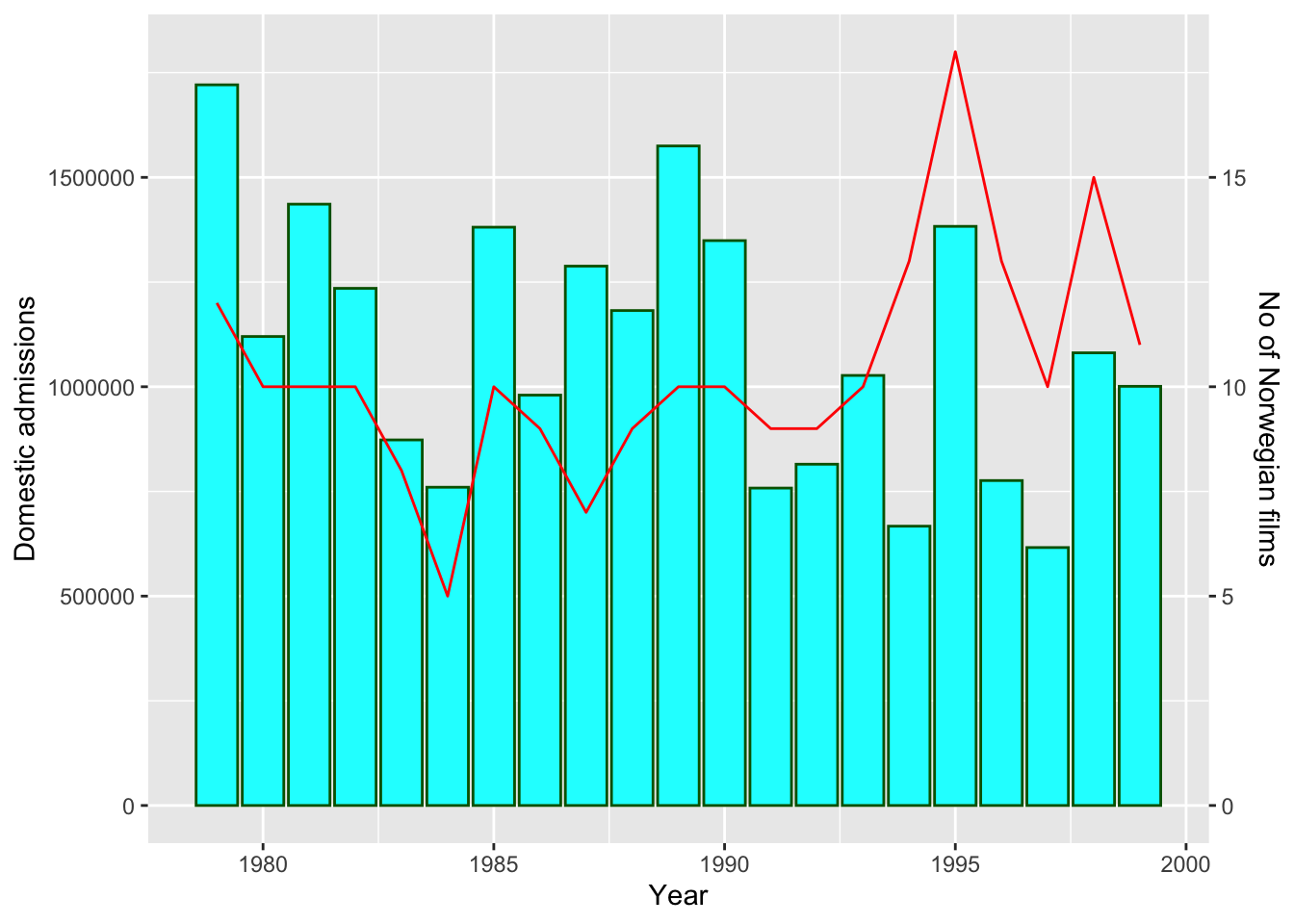
While overproduction does not seem like a viable strategy on a company level, the increase in Norwegian titles since 2000 has brought not only an increase in admissions, but also an increased stability. From 1979 to 1999 the number of films produced was generally low, between five and 18 a year. The total attendance for Norwegian movies was also low, averaging at around 1 million tickets sold.
There is also little or no correlation between the number of films released and the attendance of any given year. In this period 1979 and 1989 were the best years for Norwegian movies with 1.7M and 1.6M admission from 12 and 10 movies respectively. However, the worst years, 1994 and 1997 saw only 667,000 and 616,000 admissions from 13 and 10 movies. Admissions could also vary wildly from year to year, as high admissions were usually caused by one or two unusually successful movies. In 1995 admissions for Norwegian movies reached almost 1.4M, more than twice the year before - and then fell to 776,000 in 1996.
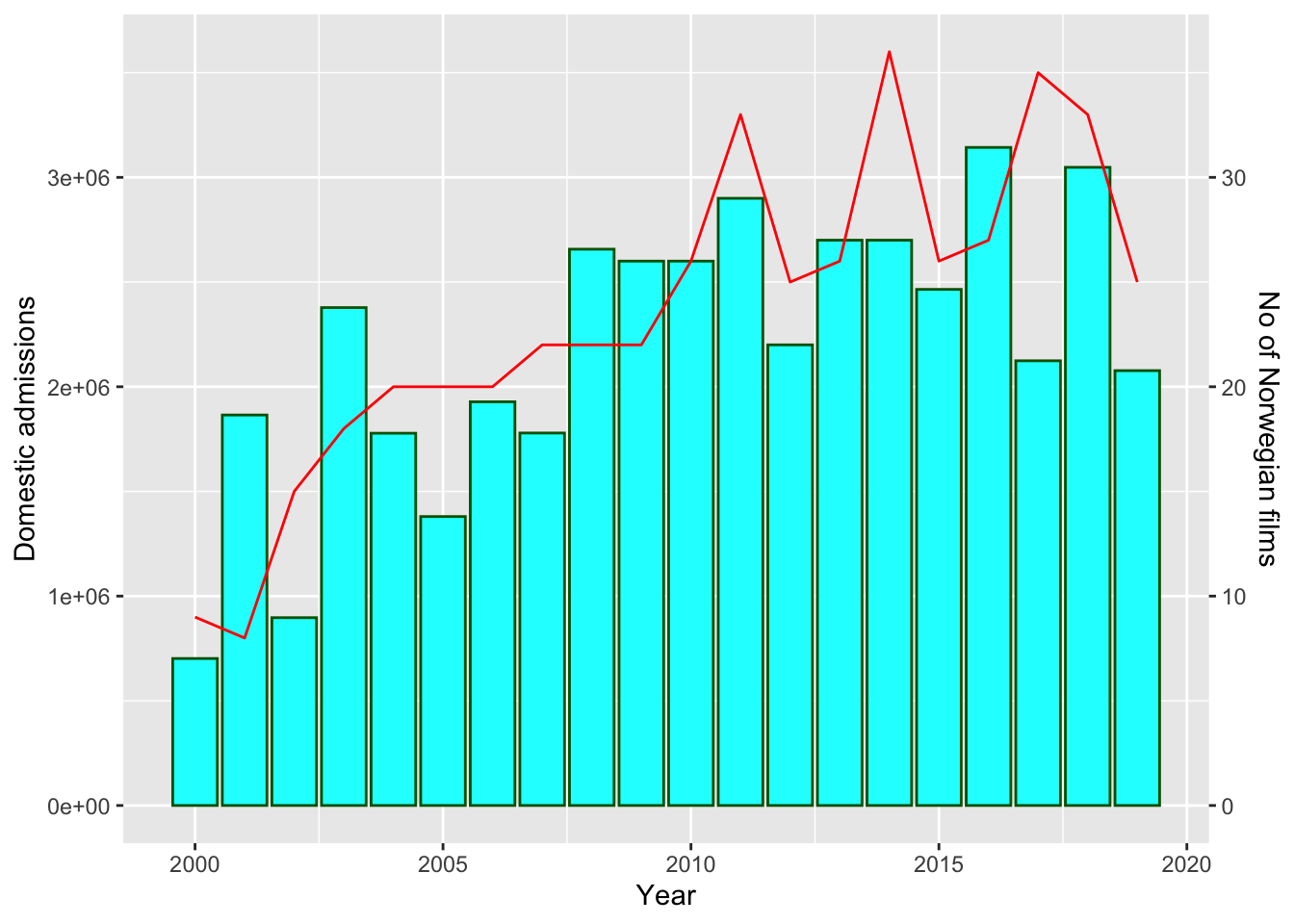
In the early 2000s, new government policies and a greater professionalisation of the industry led to an upturn in Norwegian film production. Starting in 2002 there was a notable increase in the national production, and from 2004 onwards, between 20 and 36 Norwegian movies were released every year4.
Total admissions for Norwegian movies also rose, and in 2003 the 2M barrier was broken for the first time since 19755(Film og Kino 1979). The yearly variations remained strong up to 2005, but as the number of yearly titles increased the total admissions stabilised. The most remarkable about 2008 is not that broke the 2.5M barrier, but that admissions remained stable at this record level.
While the success of Norwegian movies since 2008 cannot be reduced to a question of production volume alone, figures 3 and 4 suggest a connection. As long as there have been at least 22 Norwegian movies in cinemas, admissions have averaged 2.5M. However, more than 22 movies do not seem to have any further effect. While this suggests that overproduction can function as a strategy to achieve stability, the number of movies needed suggests this is not possible for Norwegian production or distribution companies alone.
Identifying strategy
Yet, even if key strategies are not available to local distributors, they continue to exist. The question of what their strategies have been and how they have adapted to digitalisation must then start with the distributors.
Defining distributor
A definition of Norwegian film distributors could use several different criteria for defining either “Norwegian” or “film” or “distribution”. A “Norwegian” distributor might be: (1) A company that distributes films in Norway. (2) A Norwegian company that distributes films. (3) A company that distributes Norwegian films. A “film” distributor might be: (1) A company that distributes films in cinemas. (2) A company that distributes films online. (3) A company that distributes films on DVD/Blu-ray. A “distributor” might be: (1) A company that imports film. (2) A company that invests in local film. (3) A company that markets films.
This thesis defines “Norwegian distributors” as companies that distributes films in Norwegian cinemas, and “local distributors” as distributors who release Norwegian movies in Norwegian cinemas. This distinction allows differentiating distributors based on their function in the local film industry rather than their country of origin.
Defining Norwegian distributors as only Norwegian companies would exclude the Swedish subsidiary SF Studios and the Danish subsidiary Nordisk Film Distribusjon, despite these companies releasing about half of all Norwegian movies. On the other hand defining Norwegian distributors as only those that release Norwegian movies would exclude Norwegian companies.
There are also companies that only release titles in Norwegian home entertainment markets, they are only included in this study insofar as they distribute titles that have been in cinemas. This delimitation also excludes companies that only market movies. While there are Norwegian companies that specialise in film marketing, they are hired by companies that release movies in Norwegian cinemas (Holmene 2018).
Areas of strategy
Distributor strategies are examined using Mintzberg’s “Five P’s for Strategy” (1987), plan, ploy, pattern, position, and perspective as discussed in chapter 1. This analysis is organised around four areas, corporate strategies, acquisition strategies, cinema release strategies and home entertainment strategies. These areas could be viewed as groupings of related tasks in Lotz’ (2021) framework.
The four strategic areas were identified using empirical data about Norwegian film distribution, and are therefore specific to Norwegian film distributors. However, corporate strategies exist in all industries, and the other strategic areas are all shaped by the Norwegian film distributors’ performance of the commodification function. It is therefore likely that strategies of companies performing the commodification function in other, similar cultural industries, can be grouped in similar ways.
In addition to these four areas, Norwegian distributors also make strategic decisions regarding marketing (Holmene 2020). However, these are not analysed here because collecting the data required would be too time-consuming for this thesis.
Corporate strategies, or corporate level strategies, are business decisions not directly connected to individual films, but which centre around the running of the company and its dealings with other companies. Corporate strategies exist in all industries and generally aim to reduce transaction costs, attract capital, and allow expansion (Douma 2017).
As Norwegian film distributors all perform the commodification function – they acquire the rights to turn movies, in various stages of production, into products that can be sold and screened. How they acquire these rights is the most important strategic decision distributors make on a regular basis.
After acquiring distribution rights, Norwegian distributors further perform the commodification function by marketing movies and deciding when and how to release them for dissemination. Until very recently, as discussed in Chapter 3, all Norwegian movies were first released in cinemas. Cinema release strategies are therefore of vital importance, especially for Norwegian movies. While foreign movies can to some extent rely on word-of-mouth and marketing from other markets, the commercial fate of Norwegian movies is more often than not decided during the opening weekend. In the limited degree marketing strategy is discussed in this thesis, is as a part of cinema release strategies.
While the decision to open widely, in many cinemas, or narrowly, selecting only a few cinemas in the beginning, is regarded as a key distribution strategy in the film industry more broadly (Crisp 2015, 28–29), narrow releases are seldom considered by Norwegian distributors. Most Norwegian movies tend to open as widely as possible, and after the digitalisation of the cinemas this tends to mean a movie either opens in a cinema on the premiere date or not at all. This approach is the subject of some discussion and may yet shift – as the case studies show, more varied release strategies may be adopted.
The final major strategic decision distributors make is when and how to do home entertainment releases. Home entertainment strategies cover both the length of each release window, pricing decisions and other decisions aimed at increasing revenue or prominence in home entertainment formats.
References
Crisp, Virginia. 2015. Film Distribution in the Digital Age: Pirates and Professionals. Basingstoke, Hampshire: Palgrave Macmillan. https://doi.org/10.1057/9781137406613.
Douma, Sytse W. 2017. Economic Approaches to Organizations. Sixth edition. Harlow, England: Pearson.
Holmene, Ingeborg. 2020. “Forestilte publikum : Casestudier av den norske film- og tv-bransjens strategier for sosiale medier (2015-2018).”196. PhD thesis, Høgskolen i Innlandet. https://brage.inn.no/inn-xmlui/handle/11250/2686907.
Jenkins, Barry. 2018. “If Beale Street Could Talk.” Drama, {{Romance}}. Annapurna Pictures, Plan B Entertainment, PASTEL. https://www.imdb.com/title/tt7125860.
Lotz, Amanda D. 2021. “In Between the Global and the Local: Mapping the Geographies of Netflix as a Multinational Service.”International Journal of Cultural Studies 24 (2): 195–215. https://doi.org/10.1177/1367877920953166.
Mintzberg, Henry. 1987. “The Strategy Concept I: Five Ps For Strategy.”California Management Review 30 (1): 11–24. https://doi.org/10.2307/41165263.
Moseng, Jo Sondre. 2016. “Produksjonslandskapet i Norsk Film.” In Bak Kamera: Norsk Film Og TV i Et Produksjonsperspektiv, edited by Eva Bakøy, Roel Puik, and Tore Helseth.
———. 2017. “The Film and Television Industries in Norway.” In Building Successful and Sustainable Film and Television Businesses : A Cross-National Perspective, edited by Eva Bakøy, Roel Puijk, and Andrew Spicer. Intellect.
Russo, Anthony, and Joe Russo. 2019. “Avengers: Endgame.” Action, {{Adventure}}, {{Drama}}. Marvel Studios, Walt Disney Pictures. https://www.imdb.com/title/tt4154796.
Zito, Joseph. 1984. “Friday the 13th: The Final Chapter.” Horror, {{Thriller}}. Paramount Pictures, Georgetown Productions Inc., Sean S. Cunningham Films. https://www.imdb.com/title/tt0087298.
I found no recent recognizable US titles at this budget level, but an older comparison is the $2.6M budget for Friday the 13th Part IV: The Final Chapter(Zito 1984).↩︎
27 Norwegian movies were released in both 2020 and 2021, despite the COVID-19 restrictions that closed cinemas for significant parts of both years. (Film og Kino 2022)↩︎
It was only the third time in history Norwegian movies had reached 2M admissions. 1974 saw 2.6M admissions and the 1975 record of 3.3M admissions remains unbroken.↩︎