Appendix C — Acquisition strategies
The kind of movies the distributor acquires and what level of investment the distributor offers is the strongest factor in determining the company’s position in the market. Almost all Norwegian distributors acquire foreign rights, invest in foreign movies through the acquisition of local screening rights of individual titles or through output deals with foreign studios such as Hollywood studios. Their investment in and dependence on local movies, however, varies greatly.
C.0.0.1 Investment level
The cost of marketing and acquiring foreign titles is not public knowledge in Norway, but it is safe to assume that it is, over time, closely linked to admissions. From Figure 8 we see Hollywood subsidiaries are, unsurprisingly, among those investing the most. However, we also see that SF Studios and Sandrew Metronome invested considerably in foreign titles.
While Nordisk Film Distribusjon invests considerably less in foreign titles than the other high-resource companies, its investment in local movies is significant; the company distributed more than half the expensive market scheme movies released between 2011 and 2015. Along with SF Studios, Nordisk Film Distribusjon also invested in significantly more local movies than the other distributors.
The Norwegian 2019 releases confirm closely to expectations.[^84] The high-resource distributors released the most expensive titles and spent more on marketing. Nordisk Film Distribusjon released four of the five market path titles, as well as the two most expensive artistic path titles. SF Studios released the most expensive local title of 2019, Amundsen. SF Studios’ artistic path title was the third most expensive artistic path title of 2019. Norsk Filmdistribusjon also confirmed their position as the lead independent by releasing four local titles, while none of the other low-resource distributors released more than one.
C.0.0.2 Release frequency
The high-resource vs. low-resource pattern was again found in the release frequency, although it is far less pronounced. The companies that released the most titles were high-resource companies, and the companies releasing the fewest were low-resource companies, but the low-resource companies with the highest frequencies overlapped with the high-resource companies with lower frequencies.
Additionally, the companies that released a larger number of titles have a more consistent volume of releases. Most distributors released titles at fairly consistent intervals from year to year, and any interruptions in this cadence are largely part of a change in strategy, or exceptional years. Moreover, the frequency of foreign movies was generally more stable than the frequency of local movies.
C.0.0.3 Norwegian vs. foreign titles
The main area where the high versus low-resource pattern does not apply is the distributors’ reliance on local movies – Figure 12 shows high- and low-resource distributors at both ends of the graph.[^85] In general, acquiring foreign rights carry less risk than investing in local production: investments are lower, and stars and predictably bankable content mitigate risk.
Foreign movies also tend to be finished and can therefore be assessed on their quality as well as their promise. It is no surprise, then that all Norwegian distributors that release Norwegian titles also release foreign titles.
C.0.0.4 Known or original
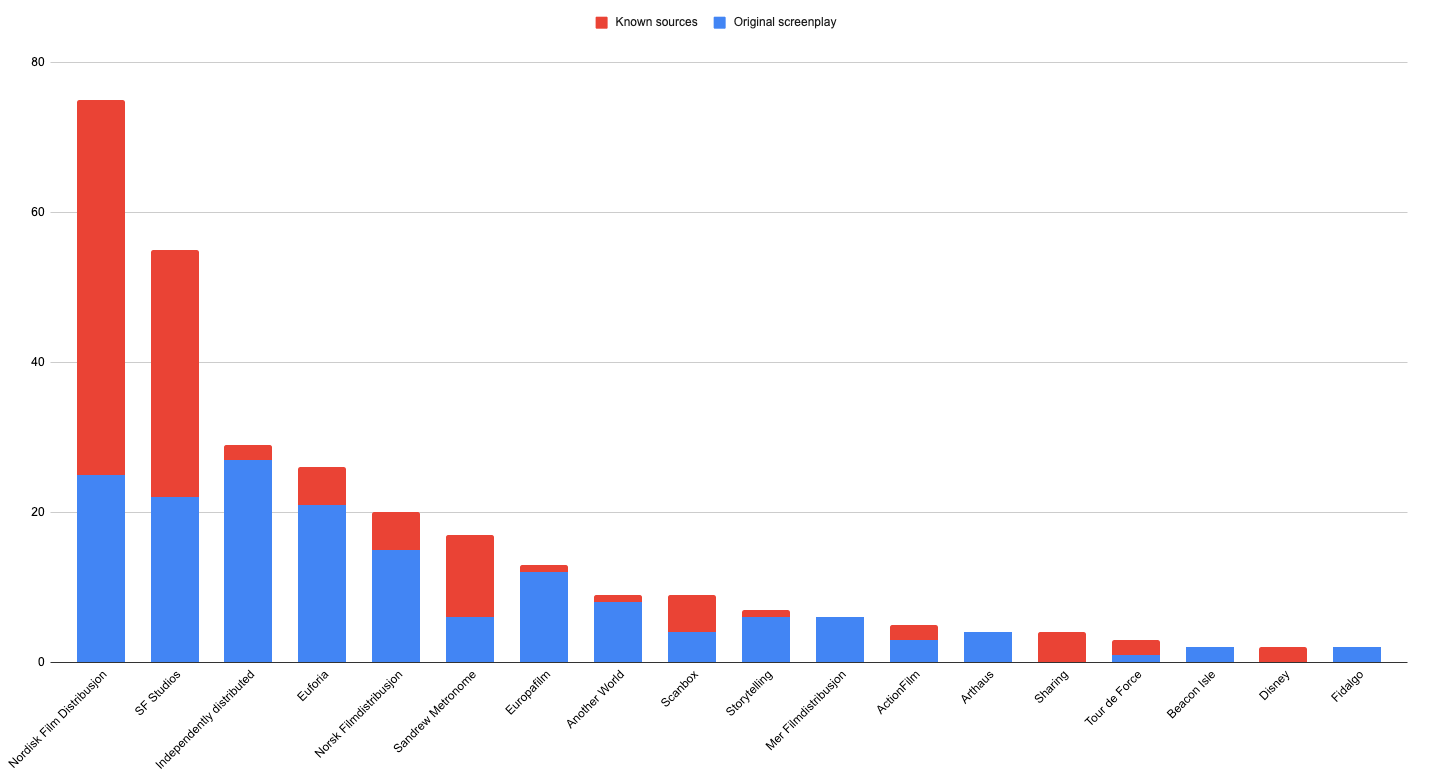
The high- vs. low-resource pattern emerges again with the sourcing of screenplays for local movies – SF Studios and Nordisk Film Distribusjon distributed significantly more movies with screenplays based on known content than original screenplays. The low-resource distributors released far more local movies based on original stories than based on known content.
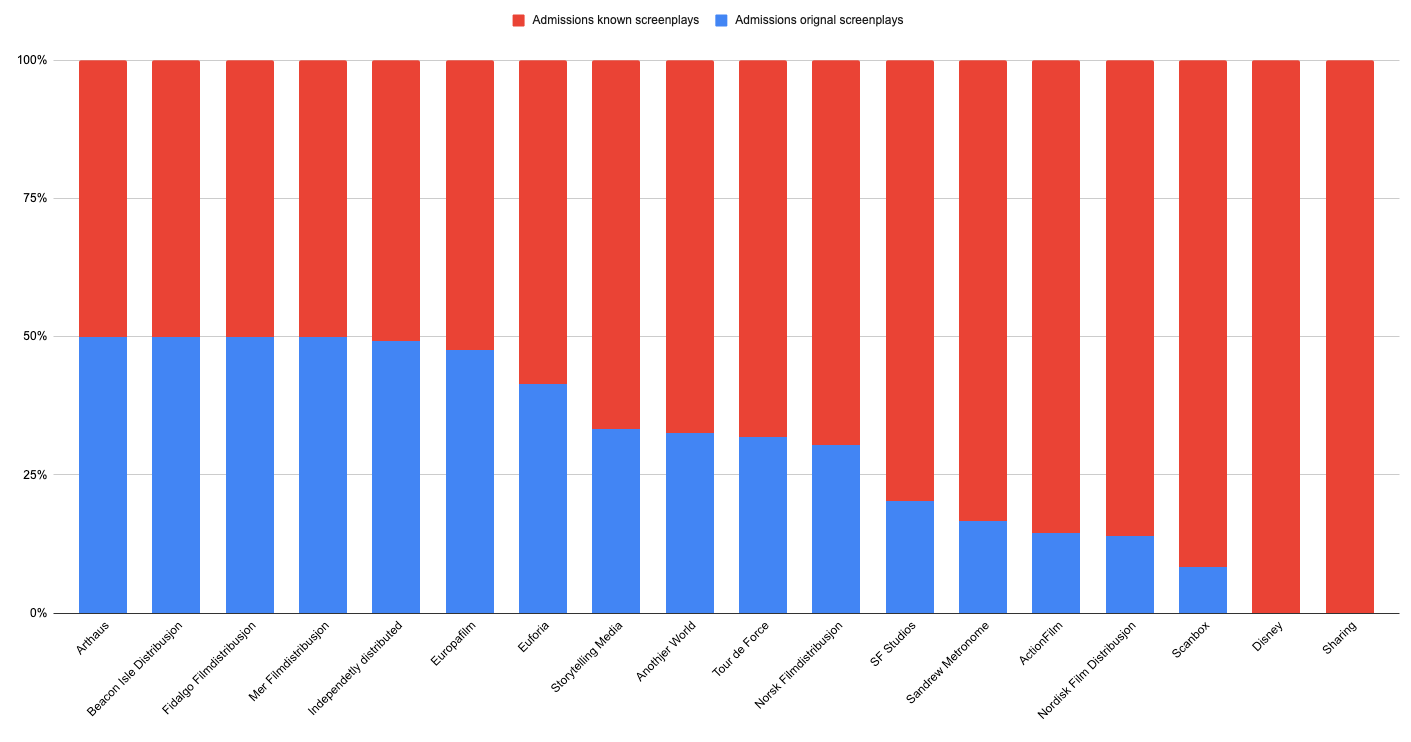
For Norsk Filmdistribusjon and others that released more original than known content movies, the latter still provided a significant portion of all admissions combined. This suggests that even though these movies may be more expensive, they pull significant weight commercially.
C.0.0.4.0.1 Table 30: Source of screenplays for local 2019 titles
| Norwegian title | Distributor | Screenplay based on |
| Psychobitch | Norsk Filmdistribusjon | Original story |
| Born2Drive | Norsk Filmdistribusjon | Documentary |
| Amundsen | SF Studios | Historical events |
| Kamel | Tour de Force | Documentary |
| Ut og stjæle hester | Nordisk Film Distribusjon | Novel |
| Jeg ser deg | Europafilm | Documentary |
| Askeladden - I Soria Moria slott | Nordisk Film Distribusjon | Fairytale, Sequel |
| Hjelperytteren | Norsk Filmdistribusjon | Original story |
| Barn | Arthaus | Original story |
| Kaptein Sabeltann og Den magiske diamant | Nordisk Film Distribusjon | Play |
| Astrup - Flammen over Jølster | Norsk Filmdistribusjon | Historical events |
| Villmarksbarna - En eventyrlig reise | Storytelling | Documentary |
| Disco | Mer Filmdistribusjon | Original story |
| Brillebjørn på ferie | Selmer | TV series |
| Swingers | SF Studios | Remake |
| Spionen | Nordisk Film Distribusjon | Historical events |
| Operasjon Mumie | SF Studios | Novel |
| De dødes tjern | SF Studios | Novel |
| Snekker Andersen og Julenissen: Den vesle bygda som glømte at det var jul | Nordisk Film Distribusjon | Novel |
| Håp | SF Studios | Original story |
| Tunnelen | Nordisk Film Distribusjon | Original story |
Again, the 2019 releases closely follow expectations. Of the six titles based on original screenplays, SF Studios and Nordisk Filmdistribusjon distributed one each. If Astrup - Flammen over Jølster is defined as a documentary[^86], Brillebjørn på ferie is the only title released by a low-resource distributor based on known content.
C.0.0.5 Genre
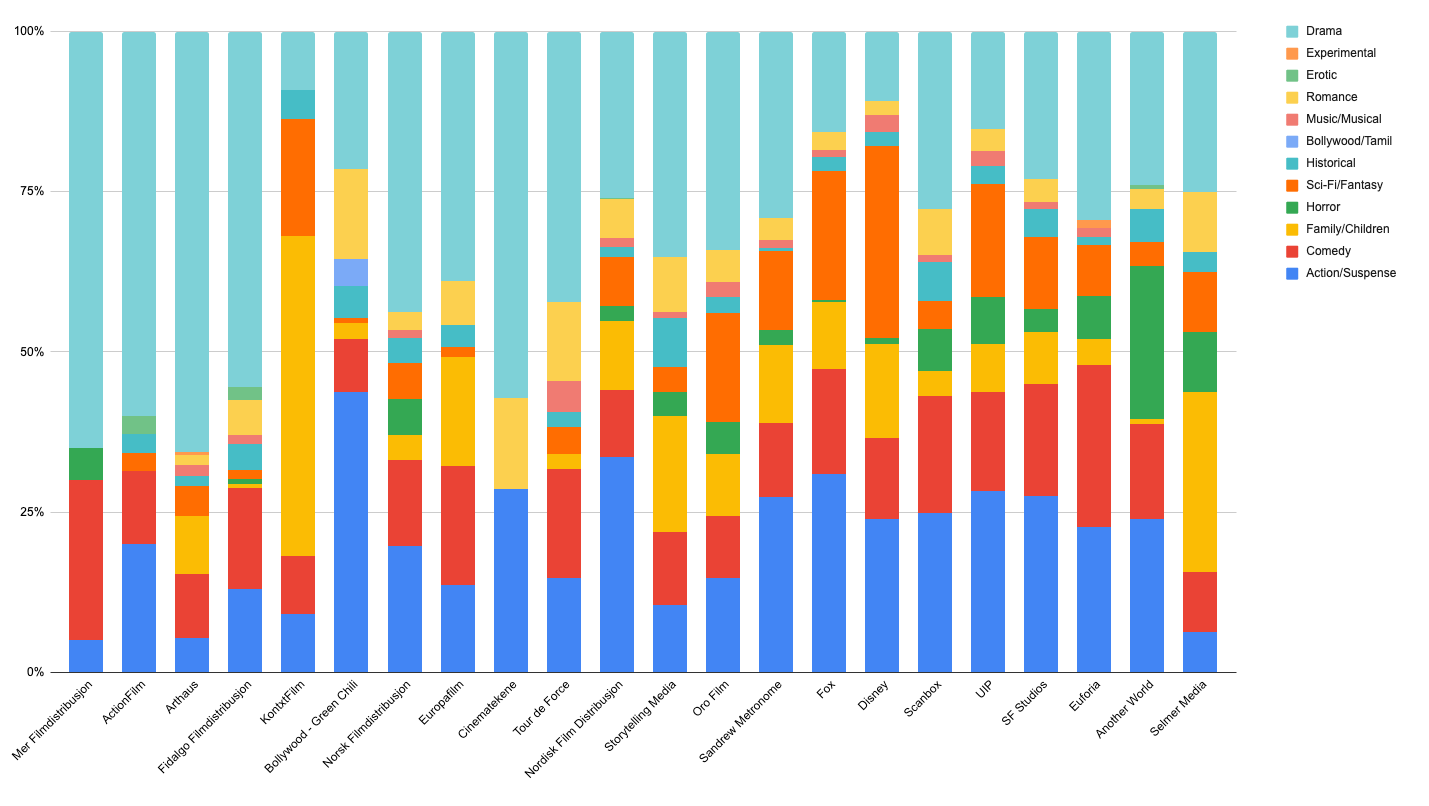
The high- vs. low-resource pattern can to some extent also be found when examining which genres of movies the distributors acquire. While high-resource companies buy a relatively even mix of genres, low-resource companies tend to be far more specialised.
As Figure 15 shows, Arthaus, Mer Filmdistribusjon and Fidalgo’s arthouse specialisation is concentrated around drama and an absence of genre movies in categories such as action, horror, and sci-fi/fantasy. Another World, on the other hand, released a significant number of horror movies, while Corianderfilm and Kontext specialised in children’s movies.
These genre preferences become stronger when local movies are included – for example, all Another World’s Norwegian movies had a connection to horror. Kontext’s one Norwegian film was a children’s movie, and all of Arthouse’s releases were dramas. Documentary specialist Tour de Force released 14 Norwegian documentaries and one Norwegian fiction film between 2008 and 2018. Tour de Force also released 26 foreign documentaries, far more than any other distributor.
C.0.0.6 Country of origin
Finally, when examining what regions distributors acquire titles from globally, we again see the high- vs. low-resource pattern. High-resource companies mainly acquire titles from the USA, while low-resource companies acquire titles mainly from Europe and/or other regions. There is some deviation, however, with Nordisk Film Distribusjon, which as fewer US titles than Norsk Filmdistribusjon.
C.0.0.7 Cinema release strategies
After acquiring distribution rights, Norwegian distributors further perform the commodification function by marketing movies and deciding when and how to release them for dissemination. Until very recently, as discussed in chapter 3, all Norwegian movies were first released in cinemas. Cinema release strategies are therefore of vital importance, especially for Norwegian movies. While foreign movies can to some extent rely on word-of-mouth and marketing from other markets, the commercial fate of Norwegian movies is more often than not decided during the opening weekend.
While the decision to open widely, in many cinemas, or narrowly, selecting only a few cinemas in the beginning, is considered a key distribution strategy in the film industry more broadly, it is not a strategy used by Norwegian distributors. Most Norwegian movies tend to open as widely as possible, and after the digitalisation of the cinemas this tends to mean a movie either opens in a cinema on the premiere date or not at all. This approach is the subject of some discussion and may yet shift – as the case studies show, more varied release strategies may be adopted.
C.0.0.7.1 Preferred dates
While foreign releases in Norwegian cinemas are spread quite evenly throughout the year, the seasonal variations for local titles are significant. Norwegian releases peak around March and September/October. Almost no Norwegian movies are released during the summer.
The high- vs. low-resource pattern is evident in the preferred dates. The autumn peak of Norwegian movies is driven by the high-resource companies, which distribute half or more of the releases from August through December. The low-resource companies tend to prefer spring releases to avoid both the dead period in the summer and the heavier competition in the autumn. This same pattern is evident in November and December, when SF Studios and Nordisk Film Distribusjon continue to release titles despite increased foreign competition, while the smaller distributors avoid these months. SF Studios and Nordisk Film Distribusjon were also the only distributors to release local movies on December 25, a very attractive date.
C.0.0.7.2 Festivals
For artistic path movies, the main factor in deciding the premiere date is finding a fitting festival in which to premiere. Artistic path movies generally depend on good reviews and word-of-mouth buzz, both of which festivals can generate.
Four of the six artistic scheme movies released in 2019 premiered at festivals. Nordisk Film Distribusjon had Ut å stjæle hester in Berlin, Arthaus showed Barn in Venice, SF Studios opened Håp in Toronto and Mer had Disco in San Sebastián. The subsequent gap between festival release and national premiere varied.
C.0.0.7.3 Seasonal content
Films that are seasonal in some ways tend to be released in approximately the same season as they take place. This is obvious in the case of Christmas movies. Every year since 2010, with the exception of 2018, saw some kind of Christmas-themed children’s movie released the first weekend of November.
Its Christmas setting was probably also a factor in releasing Håp at the end of November, a relatively long time after the Toronto premiere. Movies that are more generally “warm” or “cold”, too, tend to be released in the appropriate season. Psychobitch and Amundsen both feature copious amounts of snow and were released in late winter/early spring.
C.0.1 Home entertainment strategies
While the home entertainment market saw a dramatic fall in the number of releases in 2012, there are still substantially more titles available every week at home than in cinemas. Norwegian movies have not yet proven viable on these platforms, and so this additional volume is almost entirely made up of foreign titles. Some Norwegian TV shows do get DVD and/or TVOD/EST releases, but again this volume is small compared to the number of foreign TV shows released. The home entertainment market is therefore dominated by the high-resource foreign-led and foreign-dominated companies that acquire the rights for Hollywood movies.
All companies with a significant share of direct-to-video releases have reacted to the same trends in approximately the same manner – reducing the total number of titles, mainly by dropping re-releases. While the number of Norwegian TV shows and catalogue titles has fallen from its peak around 2010, most new Norwegian movies receive some kind of home entertainment release.
The home entertainment strategies have been analysed as a part of the overall distributor strategies. While there are clear indications that for some distributors this is the case, not all home entertainment decisions are taken by the distributor.
There are also examples where distributors have acquired home entertainment rights for older titles originally released by others. Although this has not been systematically examined, I have noticed such acquisitions by Nordisk Film Distribusjon and SF Studios. In many cases, it seems likely the home entertainment rights lay with a production company later acquired or made home entertainment deals with SF Studios or Nordisk Film Distribusjon.
One such example is that Nordisk Film Distribusjon seems to hold the rights to Elling (Me, My Friend and I, Næss 2001) and Mors Elling (Mother’s Elling, Isaksen 2003), which were produced by Maipo and originally distributed by UIP. These titles were regularly promoted as a part of the Nordisk Film+ streaming service. However, the final film in the trilogy, Elsk meg i morgen (Love me tomorrow, Næss 2005), was not, suggesting that those rights might not have been acquired.
Most of the low-resource distributors do not release home entertainment titles themselves but use specialist distributors. Euforia and Mer Filmdistribusjon release only their own cinema titles, while Star Media and Another World Entertainment are home entertainment specialists that release far more home entertainment than cinema titles. This includes both foreign and local titles originally distributed by other low-resource cinema distributors.
Success in the home entertainment market does still largely depend on success in the cinemas – distributors measure the relative success in the home entertainment markets as conversion rate, thus linking performance in the second market to the first. With that said, only limited sales numbers in the physical home entertainment markets were publicly shared, and no digital sales are shared at all, which limits data available on an individual company basis.
Reports on the top 10 best-selling DVD titles annually from 2006 to 2012 show the average conversion rate hovering just around 50% at the height of DVD sales volume. In 2012, the conversion rate fell to 36%; as sales volume dropped, sales figures were no longer shared.
C.0.1.1 Window length
Window length has been a point of contention for a few years. Cinemas have increasingly felt threatened by a shortened cinematic window, and as the home entertainment market has lost value, distributors increasingly want to draw attention from cinema releases into the home entertainment markets.
While the data on DVD release dates is limited, it does not suggest any major changes in cinematic windows for Norwegian movies in the period under discussion. However, we once again find the high- vs. low-resource pattern in this distribution channel. With the exception of Another World, whose seven non-Christmas titles were released an average of 98 days after the cinema premiere, the low-resource distributors have significantly longer windows than the high-resource distributors.
Among the smaller distributors, the long DVD windows might be the result of late decisions to release a DVD at all. Mer Filmdistribusjon’s Hoggeren (The Tree Feller, Syversen 2017) and Fra Balkongen (From the Balcony, Giæver 2017) were both released almost two years after their cinema premieres, and Mot naturen (In Natura, Giæver and Vold 2014) almost five years after its cinema premiere. All three had, however, been released digitally earlier, and the decision to release these titles on DVD coincided with the release of the very successful Hva vil folk si (What will people say, Haq 2017), 164 days after its cinema premiere.
The very shortest windows seem to be reserved for movies expected to have short cinema runs. Both SF Studios and Nordisk Film Distribusjon released documentaries on DVD just 45 days after the cinema premiere and Another World Entertainment released VampyrVidar (Vidar the Vampire, Berg 2017), a low-budget title that sold less than 2000 tickets, after 45 days.
In 2019 Hjelperytteren failed at the box office and also saw a 45-day window. This was significantly shorter than Norsk Filmdistribusjon’s other titles the same year, which all had 129-day windows. In 2019, the high- vs. low-resource pattern was not evident in the length of the cinematic windows. While Selmer’s Brillebjørn på ferie had a 120+ day window, titles from Storytelling, Arthaus and Mer Filmdistribusjon all stayed below 100 days.
A high- vs. low-resource pattern was slightly more evident in the structure of the home entertainment releases. In 2019 Nordisk Film Distribusjon consistently released titles in an EST-exclusive window followed by DVD/Blu-rays, creating a sales exclusive window before the titles were available on TVOD. SF Studios followed the same pattern, with the exception of Operasjon Mumie, which was released digitally and physically at the same time. This release, and the long EST window for Amundsen, were connected to physical campaigns and are discussed in the next chapter.
Among low-resource distributors, only Arthaus and Mer Filmdistribusjon chose similar release patterns. None of the others had EST exclusive windows, although Psychobitch had a short physical exclusive window. Hjelperytteren did not receive a physical release, and Brillebjørn på ferie had a short window where it was only available on DVD and EST, before TVOD. Astrup - Flammen over Jølster and Villmarksbarna - En eventyrlig reise were available on TVOD the same day as both EST and physical releases.
Villmarksbarna also saw a very short TVOD window, as it was broadcast by NRK and made available on the national broadcaster’s player only 28 days after the TVOD release and just 87 days after the cinema premiere. Finally, Kamel and Jeg ser deg did not see traditional home entertainment releases at all.
Only two 2019 titles, Swingers and De dødes tjern, had “dark windows” in which they were no longer in cinemas and not available as home entertainment. Both were distributed by SF Studios. However, almost all titles had made well over 90% of their total admissions by the time they were available in the home entertainment markets.
C.0.1.2 Formats
As Figure 22 shows, almost all Norwegian movies get some kind of home entertainment release. Most of these also get a physical release, and some get both DVD and Blu-ray releases[^87]. The formats in which titles are released are mainly based on expected sales, although smaller companies seem to have a higher threshold for committing to DVD and Blu-ray releases than bigger companies. The exception is the more specialised distributors, which often release Blu-rays even of poorly selling titles, and some of the smaller distributors, which forego physical releases entirely.
Another World and Arthaus have released Blu-rays of titles with less than 2000 and 8,000 admissions respectively, and only one of Another World’s 10 releases is not physically available at the time of writing.
Mer Filmdistribusjon, through Star Media, has never released a Blu-ray, not even of Hva vil folk si despite it selling more than 100,000 tickets[^88]. By contrast, high-resource distributors Nordisk Film Distribusjon and SF Studios have released Blu-rays for titles selling about 40,000 and 30,000 tickets respectively. Many of the smaller companies have most likely not released any Blu-ray titles, and some children’s movies selling more than 200,000 cinema tickets have only been released on DVD.
In 2019, SF Studios and Nordisk Film Distribusjon released all their titles on Blu-ray. With the exception of Barn, released by Arthaus, none of the low-resource distributors’ released Blu-rays.
C.0.1.3 Pricing
Unlike movie tickets, the cost of renting or purchasing a movie in the home entertainment market varies on a per title basis. The price of DVDs and Blu-rays varies slightly, though generally on the basis of how new the film is (and in some cases extra is charged for special or limited editions). No historical data is available for VOD, but there is clear evidence that new films enter the market at significantly different price points, and that pricing changes at different intervals for different titles.
The 2017 title Hva vil folk si still sells at NOK 139 on iTunes, while most 2018 titles sell at NOK 79. This difference is particularly significant as it indicates the perceived quality of titles can be linked to price – Hva vil folk si received significant critical acclaim, in addition to selling more than 100,000 tickets. Hoggeren, another 2017 release from Mer Filmdistribusjon, is at the time of writing priced at NOK 99. While Hoggeren also received critical accolades, neither the praise nor the much lower ticket sales – 15,000 – were comparable to Hva vil folk si, suggesting Mer Filmdistribusjon considers the latter a better value proposition and priced it accordingly.
C.0.1.3.0.1 Table 31: Price points for local 2019 releases
| Title | Distributor | Initial EST price point | Min Est price | Max Est after a year[^89] |
|---|---|---|---|---|
| Amundsen | SF Studios | 139 | 49 | 79 |
| Ut og stjæle hester | Nordisk Film Distribusjon | 139 | 49 | 79 |
| Askeladden - I Soria Moria slott | Nordisk Film Distribusjon | 139 | 49 | 79 |
| Kaptein Sabeltann og Den Magiske Diamant | Nordisk Film Distribusjon | 139 | 49 | 79 |
| Swingers | SF Studios | 139 | 69 | 89 |
| Spionen | Nordisk Film Distribusjon | 139 | 49 | 79 |
| Operasjon Mumie | SF Studios | 139 | 49 | 79 |
| De dødes tjern | SF Studios | 139 | 79 | 79 |
| Snekker Andersen og Julenissen: Den vesle bygda som glømte at det var jul | Nordisk Film Distribusjon | 139 | 99 | 99 |
| Håp | SF Studios | 139 | 79 | 79 |
| Tunnelen | Nordisk Film Distribusjon | 139 | 49 | 139 |
| Born2Drive | Norsk Filmdistribusjon | 99 | 79 | 99 |
| Kamel | Tour de Force | 0 | 0 | |
| Jeg ser deg | Europafilm | 0 | 0 | |
| Hjelperyttereren | Norsk Filmdistribusjon | 99 | 99 | 99 |
| Barn | Arthaus | 99 | 79 | 79 |
| Astrup - Flammen over Jølster | Norsk Filmdistribusjon | 99 | 99 | 99 |
| Villmarksbarna - En eventyrlig reise | Storytelling | 99 | 99 | 99 |
| Disco | Mer | 99 | 99 | 99 |
| Brillebjørn på ferie | Selmer | 99 | 99 | 99 |
| Benjamin Falck og Dødsdolkene | Star Media Entertainment | 79 | 79 | 79 |
| Psychobitch | Norsk Filmdistribusjon | 99 | 79 | 99 |
When examining pricing strategies in 2019, we once again find a high- vs. low-resource pattern. SF Studios and Nordisk Film Distribusjon’s pricing strategies are far more active than those of the low-resource distributors, starting higher, but adjust more quickly.
C.0.1.4 Streaming
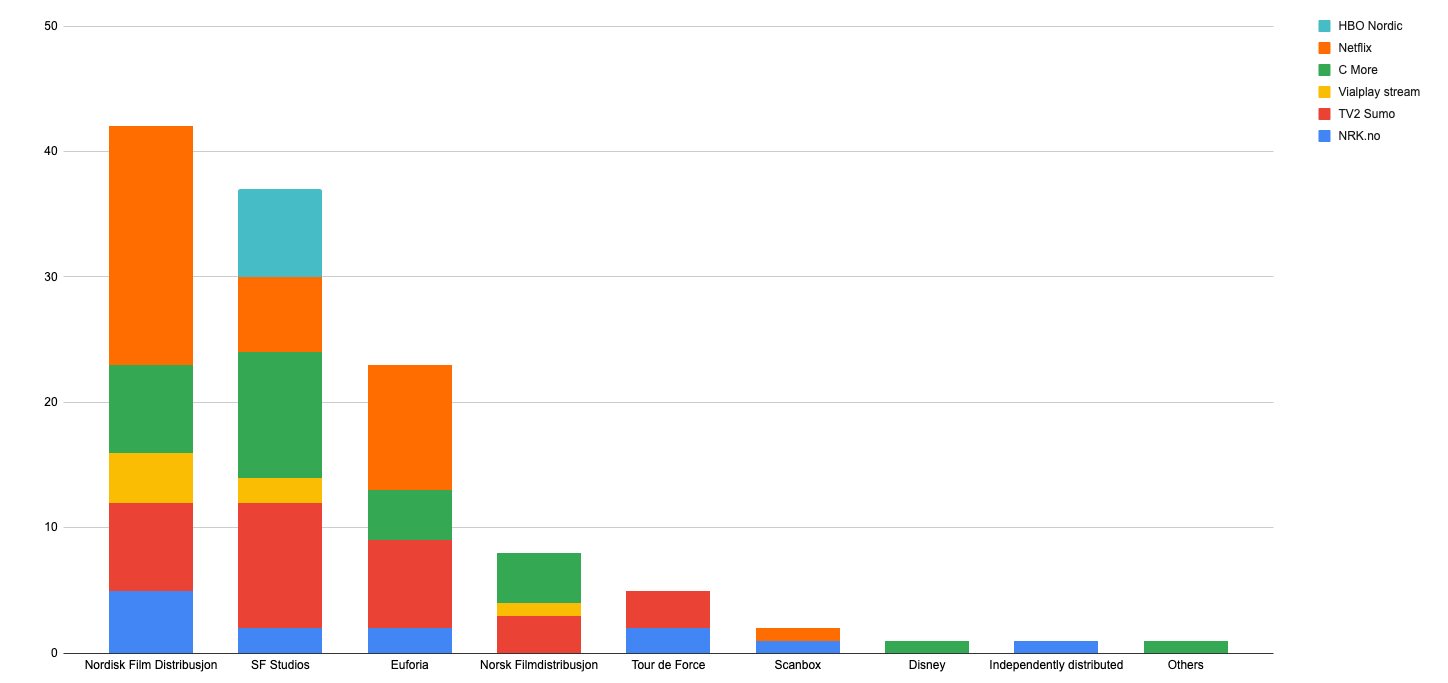
Using data from three spot-checks undertaken by NFI from 2014 to 2016, we again see a distinct difference between the high-resource distributors and the low-resource distributors. SF Studios and Norsk Filmdistribusjon had far better access to streaming services, especially Netflix and HBO. Most low-resource distributors had no titles on streaming services, however, Tour de Force released documentaries to Norwegian broadcasters, and Norsk Filmdistribusjon had some of its titles on TV2 and Scandinavian streamers. The exception among the low-resource companies is Euforia, which had nine recent titles on Netflix in 2014 as well as titles on C More and TV 2.
Streaming releases for local 2019 titles once again follow the pattern seen in other categories. With the exception of De dødes tjern, all of SF Studios’ and Nordisk Film Distribusjon’s titles went to paid SVOD services about a year after release. Barn had a similar SVOD release, unlike the other low-resource distributors whose titles went to broadcasters first.
C.0.1.4.0.1 Table 32: Streaming releases for local 2019 titles, days after theatrical
| Title | Distributor | 1st SVOD | Second SVOD | Free-to-air/streaming |
| Psychobitch | Norsk Filmdistribusjon | Amazon Prime | 743 (NRK) | |
| Born2Drive | Norsk Filmdistribusjon | 424 (Dplay) | 428 (TVNorge) | |
| Amundsen | SF Studios | 368 (C More) | 1096 (HBO) | 806 (NRK) |
| Kamel | Tour de Force | 625 (NRK) | ||
| Ut og stjæle hester | Nordisk Film Distribusjon | 376 (Viaplay) | ? (TV2 Play) | 764 (NRK) |
| Jeg ser deg | Europafilm | |||
| Askeladden - I Soria Moria slott | Nordisk Film Distribusjon | 402 (Viaplay) | 472 (TV2 Play) | |
| Hjelperytteren | Norsk Filmdistribusjon | 547 (NRK) | ||
| Barn | Arthaus | 374 (C More) | 825 (NRK) (Filmoteket) | |
| Kaptein Sabeltann og Den magiske diamant | Nordisk Film Distribusjon | 444 (Viaplay) | 923 (NRK) | |
| Astrup - Flammen over Jølster | Norsk Filmdistribusjon | 450 (NRK) | ||
| Villmarksbarna - En eventyrlig reise | Storytelling | 472 (Get) | 87 (NRK) (Filmoteket) | |
| Disco | Mer Filmdistribusjon | 424 (NRK) (Filmoteket) | ||
| Brillebjørn på ferie | Selmer | 436 (NRK) (Filmoteket) | ||
| Swingers | SF Studios | 367 (C More) | (Viaplay) | |
| Spionen | Nordisk Film Distribusjon | 400 (Viaplay) | 765 (NRK) | |
| Operasjon Mumie | SF Studios | 367 (C More) | 533 (NRK) (Filmoteket) | |
| De dødes tjern | SF Studios | Shudder (US Only) | ||
| Snekker Andersen og Julenissen: Den vesle bygda som glømte at det var jul | Nordisk Film Distribusjon | 395 (Viaplay) | 770 (NRK) | |
| Håp | SF Studios | 409 (Viaplay) | 756 (NRK) (Filmoteket) | |
| Tunnelen | Nordisk Film Distribusjon | 376 (Viaplay) | 732 (TV2 Play) |
C.0.1.5 Prominence in the home entertainment market
In general, Nordisk Film Distribusjon titles were on the iTunes front page longer than SF Studios titles, and SF Studios movies were on the front page longer than those from other distributors. Only titles from SF Studios and Nordisk Film Distribusjon remained on the iTunes front page longer than they played in cinemas.
This is most evident when looking at the children’s titles. Nordisk Film Distribusjons’ Askeladden i Soria Moria Slott and Kaptein Sabeltann og den magiske diamant not only stayed on the iTunes front page for more than a year after release, but both were visible in the Top Pre-Releases section for two months before release. SF Studios’ Operasjon Mumie did not have the same prerelease visibility, but stayed on the iTunes front page for a year.
Of the two children’s movies released by other distributors, only Brillebjørn på ferie made the iTunes front page and only for five weeks. In cinemas, however, Brillebjørn på ferie played for 32 weeks, Operasjon Mumie for 27 weeks, Askeladden - I Soria Moria slott for 36 weeks and Kaptein Sabeltann og Den magiske diamant for 49 weeks. Villmarksbarna - En eventyrlig reise had the shortest cinema run of all titles yet stayed in the Top 200 for four weeks, as long as Brillebjørn på ferie, despite Villmarksbarna - En eventyrlig reise not reaching the front page.
However, the persistent top performance of SF Studios and Nordisk Film Distribusjons’ titles did not extend to the company’s artistic path titles. Disco and Barn remained on front pages longer than SF Studio’s Håp, despite the artistic title’s higher admissions. Ut og stjæle hester stayed on the iTunes front page slightly longer and also had significantly higher admissions. Spionen was the only artistic path title to stay longer on iTunes than in cinemas.
The home entertainment performance of SF Studios and Nordisk Film Distribusjon’s local 2019 titles is further discussed in chapter 5, as is the performance of Barn.
C.0.1.5.0.1 Table 33: Weeks in cinemas and weeks on iTunes front page for Norwegian 2019 releases
| Title | Distributor | Weeks in cinemas | Weeks on iTunes front page | Weeks in iTunes Top 200 Chart |
|---|---|---|---|---|
| Amundsen | SF Studios | 29 | 11 | 16 |
| Ut og stjæle hester | Nordisk Film Distribusjon | 28 | 13 | 12 |
| Askeladden - I Soria Moria slott | Nordisk Film Distribusjon | 36 | 60 | 39 |
| Kaptein Sabeltann og Den magiske diamant | Nordisk Film Distribusjon | 49 | 61 | 42 |
| Swingers | SF Studios | 11 | 14 | 16 |
| Spionen | Nordisk Film Distribusjon | 21 | 22 | 17 |
| Operasjon Mumie | SF Studios | 27 | 53 | 30 |
| De dødes tjern | SF Studios | 10 | 9 | 5 |
| Snekker Andersen og Julenissen: Den vesle bygda som glømte at det var jul | Nordisk Film Distribusjon | 15 | 22 | 9 |
| Håp | SF Studios | 26 | 6 | 5 |
| Tunnelen | Nordisk Film Distribusjon | 33 | 47 | 38 |
| Born2Drive | Norsk Filmdistribusjon | 18 | 1 | 7 |
| Hjelperyttereren | Norsk Filmdistribusjon | 8 | 0 | 0 |
| Barn | Arthaus | 29 | 12 | 10 |
| Astrup - Flammen over Jølster | Norsk Filmdistribusjon | 25 | 0 | 0 |
| Villmarksbarna - En eventyrlig reise | Storytelling | 21 | 0 | 4 |
| Disco | Mer | 25 | 8 | 13 |
| Brillebjørn på ferie | Selmer | 32 | 5 | 4 |
| Benjamin Falck og dødsdolken | Star Media Entertainment | 0 | 2 | 1 |
As Table 35 shows, SF Studios and Nordisk Film Distribusjon’s catalogue titles clock impressions far above those of other distributors. There are likely several reasons for this. Among these, Nordisk Film Distribusjon’s deals with TV2 and Viaplay boosted the prominence of their titles, as did Euforia’s deal with Get/Teliaplay.
The effect of using price to achieve prominence is evident with Pornopung (Crack, Back & Sack, Kaos 2013), which represents half of Norsk Filmdistribusjon’s impressions on iTunes, also demonstrates the impact of using price to achieve ranking prominence. Pornopung rental is consistently priced at NOK 9 and the movie regularly shows up in the 9 KR Rental section on iTunes. However, as the only Norsk Filmdistribusjon title with this pricing strategy, it seems likely the decision was made by its producers, not distributors.
C.0.1.5.0.2 Table 34: Corporate structure of Norwegian distributors
| Distributor | Location | Parent Company/Major Stockholder | Parent Company Type | Selected integrations |
| United International Pictures | Oslo | Universal & Paramount | Hollywood Majors | Paramount+ is available in Norway, and the service will be relaunched as SkyShowtime and include NBCUniversal. Neither has any other Norwegian presence. |
| Twentieth Century Fox Norway | Oslo | The Walt Disney Company | Hollywood Major | Run as a local office owned by Twentieth Century Fox until 2020. |
| The Walt Disney Company Nordic | Oslo | The Walt Disney Company | Hollywood Major | The Norwegian office is registered as a local branch of a foreign company. Disney has no other company level presence in Norway, but Disney+ and several Disney channels are available. |
| Nordisk Film Distribusjon | Oslo | Egmont | Danish Publishing Conglomerate | Production companies: Maipo, Friland, Nordisk Film Production. Cinemas: The Nordisk Film Kino chain and Drammen Kino, ticket sales portal Filmweb and cinema advertising company Media Direct Norge. Television: TV2 with several production companies and TV distributor RiksTV. Publishing: Cappelen Damm, Story House, Egmont Kids. Similar structure in Denmark and Sweden, which includes international sales agent Trust Nordisk. |
| SF Studios | Oslo | Bonnier | Swedish Publishing Conglomerate | Production companies: Filmkameratene, Paradox, Motion Blur. SF Studios has similar structures in Sweden and Finland and Bonnier is a major publisher in Sweden. |
| Sandrew Metronome | Oslo | Schibsted | Norwegian Media Conglomerate | When Schibsted owned Norsk Filmdistribusjon it operated as Sandrew Metronome and included cinema ownership in Sweden and Finland. Sandrew Metronome remains active in Denmark and in the Norwegian home entertainment market. |
| Norsk Filmdistribusjon | Oslo | SHOLDING | Norwegian cultural industries holding company | SHOLDING also owns VOD-portal Nettkino and cultural industries promotion agency Kulturmeglerene. |
| Distributor | Location | Parent Company/Major Stockholder | Parent Company Type | Selected integrations |
| Scanbox | Oslo | Scanbox | Danish film distribution company | No longer active in the Norwegian cinema market, but remains in the home entertainment market |
| Euforia | Oslo | Storm Group AS | Norwegian property developer | Storm Group also owns the production company Storm Films AS and Storm Studios AS |
| Arthaus | Oslo | None | Norwegian non-profit foundation | Co-owner in and co-located with arthouse cinema and theatre Vega Scene. |
| Mer Filmdistribusjon | Oslo | Mer Film | Norwegian production company | Mer Film is a production company. While Mer Film is located in Bergen and Tromsø, Mer Filmdistribusjon is located in Oslo |
| Another World Entertainment | Oslo | VME | Norwegian Record company | Has a Danish sister company, Another World Entertainment Denmark, founded by VME |
| Storytelling Media | Trondheim | Trondheim Municipality | Norwegian Municipality | Storytelling is owned Trondheim Kino, a municipally owned cinema. |
| Europafilm | Oslo | Evil Doghouse Studios | Norwegian production company | Evil Doghouse also runs several small production offices. |
| Tour de Force | Bergen | None | ||
| Fidalgo Filmdistribusjon | Kristiansand | None | ||
| Bollywood - Green Chili | Oslo | None | ||
| KontxtFilm | Oslo | None | ||
| Selmer Media | Oslo | None |
C.0.1.5.0.3 Figure 8: Average yearly admissions for foreign titles

C.0.1.5.0.4 Figure 9: Number of local movies released 2011 – 2015 by path

C.0.1.5.0.5 Figure 10: Number of average yearly releases
C.0.1.5.0.6 
C.0.1.5.0.7 Figure 11: Number of average yearly releases vs. median yearly releases[^90]
C.0.1.5.0.8 
C.0.1.5.0.10 
C.0.1.5.0.11 Figure 13: Number of local titles with screenplays based on known sources or original stories

Figure 14: Share of admissions from local titles with screenplays based known sources or original stories

C.0.1.5.0.12 Figure 15: Share of foreign movies by genre

C.0.1.5.0.14 
C.0.1.5.0.16 
C.0.1.5.0.17 Figure 18: Total foreign releases by month from 2008 - 2018[^91]
C.0.1.5.0.18 
C.0.1.5.0.19 Figure 19: Total Norwegian released by month from 2008 - 2018

C.0.1.5.0.21 
C.0.1.5.0.22 Figure 21: Average number of home entertainment releases 2008 – 2018[^92]
C.0.1.5.0.23 
C.0.1.5.0.25 
C.0.1.5.0.26
C.0.1.5.0.27 Figure 23: Average conversion rate of top selling DVDs
C.0.1.5.0.28 
C.0.1.5.0.29 Figure 24.: Average DVD window length, Norwegian 2008-2018 titles[^93]
C.0.1.5.0.30 
C.0.1.5.0.31 Figure 25: Window lengths of Norwegian 2019 titles[^94]
C.0.1.5.0.32 
C.0.1.5.0.34 
C.0.1.5.0.36 
C.0.1.5.0.37 Figure 28: Number of titles in streaming services

C.0.1.5.0.39 
C.0.1.5.0.40 Table 35: Prominence of catalogue titles[^96]
| Distributor | No. Norwegian movies | iTunes | Altibox | Get/Teliaplay | Google Play | Blockbuster | Viaplay Store | TV2 | Viaplay | Total |
| SF Studios | 59 | 1,03 | 3,10 | 2,58 | 1,31 | 0,00 | 9,17 | 5,25 | 0,44 | 22,88 |
| Nordisk Film Distribusjon | 75 | 0,95 | 1,31 | 5,88 | 1,39 | 0,00 | 5,48 | 12,59 | 4,35 | 31,93 |
| Euforia | 27 | 0,04 | 0,00 | 11,30 | 0,07 | 0,00 | 0,00 | 0,15 | 0,00 | 11,56 |
| Norsk Filmdistribusjon | 42 | 1,19 | 0,00 | 0,19 | 0,21 | 0,02 | 0,00 | 0,90 | 0,00 | 2,52 |
| Independent distribution | 25 | 0,00 | 0,00 | 0,32 | 0,32 | 0,00 | 0,64 | 0,00 | 0,00 | 1,28 |
| ActionFilm | 5 | 0,60 | 0,00 | 0,00 | 0,00 | 0,00 | 0,00 | 0,00 | 0,00 | 0,60 |
| Sharing | 4 | 0,00 | 0,00 | 0,00 | 0,00 | 0,00 | 1,25 | 2,50 | 0,00 | 3,75 |
| The Walt Disney Company Nordic | 2 | 0,00 | 0,00 | 0,00 | 0,00 | 0,00 | 0,00 | 4,50 | 0,00 | 4,50 |
| Storytelling Media | 8 | 0,00 | 0,00 | 0,25 | 0,13 | 0,00 | 0,00 | 0,00 | 0,00 | 0,38 |
| Another World Entertainment | 10 | 0,00 | 0,00 | 0,10 | 0,00 | 0,00 | 0,00 | 2,90 | 0,00 | 3,00 |
| KontxtFilm | 1 | 0,00 | 0,00 | 0,00 | 0,00 | 0,00 | 0,00 | 0,00 | 0,00 | 0,00 |
| Arthaus | 3 | 0,00 | 0,00 | 0,00 | 0,00 | 0,00 | 0,00 | 0,00 | 0,00 | 0,00 |
| Tour de Force | 16 | 0,00 | 0,00 | 0,00 | 0,00 | 0,00 | 0,00 | 0,00 | 0,00 | 0,00 |
| Beacon Isle Distribusjon | 2 | 0,00 | 0,00 | 0,00 | 0,00 | 0,00 | 0,00 | 0,00 | 0,00 | 0,00 |
| Europafilm | 9 | 0,00 | 0,00 | 0,00 | 0,00 | 0,00 | 0,00 | 0,00 | 0,00 | 0,00 |
| Mer Filmdistribusjon | 5 | 0,00 | 0,00 | 0,00 | 0,00 | 0,00 | 0,00 | 0,00 | 0,00 | 0,00 |
| Scanbox | 8 | 0,00 | 0,25 | 0,00 | 0,00 | 0,00 | 1,25 | 1,63 | 3,38 | 6,50 |
| Selmer Media | 1 | 0,00 | 0,00 | 0,00 | 0,00 | 0,00 | 0,00 | 0,00 | 0,00 | 0,00 |
| Tour de Force | 16 |